
You have no items in your cart.
Stay informed of the latest news and specials.
1 Ascension Place, Rosedale, Auckland 0632
Deliveries to: 5/20 Constellation Drive,
Rosedale,
North Shore,
Auckland 0632
Ph: +64 9 444 7698
Maximum of 6 rock lobster (both species combined) on any one day.
Except Te Arai Point, Auckland to Cape Runaway where a total of 3 spiny rock lobsters can be taken, and the remainder (up to 6 in total) can be packhorse rock lobster. If no spiny rock lobsters are taken at the same time, 6 packhorse lobsters can be taken.
Rules changing in CRA2 area from 1 July 2020
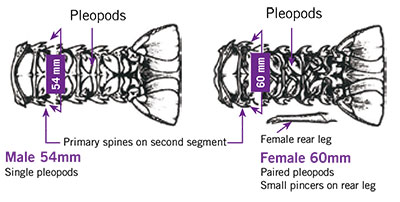
Measure the tail width in a straight line between the tips of the two large (primary) spines on the second segment of the tail. If you are unsure of the sex, use the 60mm measurement.
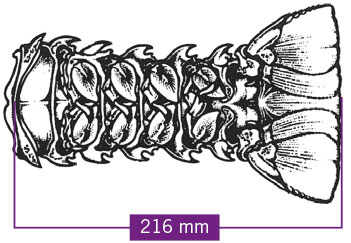
Measure the tail length along the underside in a straight line from the rear of the calcified bar on the first segment to the tip of the middle fan of the tail. Must have a tail length of at least 216mm (male and female).
There are rules and protections for gathering rock lobster/crayfish that cover: protected types, gathering methods, pot construction and use.
From Te Arai Point, Auckland to Cape Runaway telson clipping is required for all recreationally harvested spiny rock lobsters. The last third of the telson (central part of the tail fan) must be cut off so that it is noticeably shorter than the other sections of the tail fan. This must be done to all legal spiny rock lobsters as soon as they are taken.
Labelled diagram of a telson-clipped lobster [PDF, 551 KB]
Do not telson clip any packhorse rock lobsters.
Maximum of 6 rock lobster (both species combined) on any one day.
Except Te Arai Point, Auckland to Cape Runaway where a total of 3 spiny rock lobsters can be taken, and the remainder (up to 6 in total) can be packhorse rock lobster. If no spiny rock lobsters are taken at the same time, 6 packhorse lobsters can be taken.
Rules changing in CRA2 area from 1 July 2020
Measure the tail width in a straight line between the tips of the two large (primary) spines on the second segment of the tail. If you are unsure of the sex, use the 60mm measurement.
Measure the tail length along the underside in a straight line from the rear of the calcified bar on the first segment to the tip of the middle fan of the tail. Must have a tail length of at least 216mm (male and female).
There are rules and protections for gathering rock lobster/crayfish that cover: protected types, gathering methods, pot construction and use.
From Te Arai Point, Auckland to Cape Runaway telson clipping is required for all recreationally harvested spiny rock lobsters. The last third of the telson (central part of the tail fan) must be cut off so that it is noticeably shorter than the other sections of the tail fan. This must be done to all legal spiny rock lobsters as soon as they are taken.
Labelled diagram of a telson-clipped lobster [PDF, 551 KB]
Do not telson clip any packhorse rock lobsters.
It was also an amazing year for diving and our return trip to the Galapagos Islands was even better than our previous trip in 2014!
Let me paint a picture – we’re sitting on the liveaboard boat at Darwin Island – over 165 nautical miles north of Galapagos’ main islands, we've crossed the equator overnight and just arrived that morning…
We look out towards Darwin Arch less than 1km away, just down the coast we can see a mother Humpback Whale teaching its baby to slap its tail on the surface, around the boat we count 6 turtles relaxing on the surface, 7 Silky sharks are swimming under the boat, then suddenly a school of Mobula Rays are jumping into the air as they swim past, and the biggest school of dolphin any of us has even seen is in the distance leaping and playing as only they can… this isn’t over the morning – this is all at the same time! To say we were excited to get in the water was the biggest understatement you can imagine… we were all buzzing to get under Darwin Arch!
Click here for the first batch of pictures we've managed to sort through!
Heading out towards the arch on one of the two inflatables – our boat driver suddenly yells out “Whale Shark right below us... get ready to go” heart racing gear in place camera in hand, “3, 2, 1, go as the inflatable slows down ahead of the whale shark – we backward roll in – I'm lucky – I'm at the front of the RIB and manage to swim ahead and slowly let her catch up to me and we’re only 3m below the surface! I angle to be above her and swim to get into the pressure wave above her head… always mindful of never touching – and manoeuvring so I'm in the sweet spot. I don’t have to fin as hard – I'm being pulled along with her – it feels amazing, I quickly look back and a couple of divers are still swimming trying to keep up – the others have peeled off towards the arch.
She angles down and takes me on a 9-minute swim to 30m – several Giant Trevally come and join me above her head… they don’t stay long as almost unbelievably she swims through a school of hammerhead sharks!Truly one of the most epic moments I've had underwater in my 36 years of diving! She turns – I'm trying to remember to take pictures but I don’t want to waste this experience looking through the lens… she starts to ascend – too quickly for me to safely stay with her… so I peel off to the side – making sure the Go Pro on top of my camera captures her disappearing up into the blue shallows around the arch… she’s gone – I turn to high five the others (if they're still there) and a second whale shark is 4m away swimming straight towards me! I move up above and out of the way and let her pass underneath me and I swim on her back for the next couple of minutes and realise just how lucky I've been on my first dive at Darwin Arch – and that was just the first 15 minutes!
Over the seven days we’re on board Galapagos Aggressor we swim with hundreds of Hammerheads, Turtles, and many more Whale Sharks – not to mention the Seals, Sealions, Marine Iguana, Sunfish, huge schools of Barracuda – this really is scuba diving heaven… We climb an extinct volcano and get incredible pictures of the wild landscape, we visit the giant tortoises and tour around finding penguins. We eat great food, drinks, and have some late nights playing our new favourite dice game “Zilch” (thanks Willie). This made for another epic trip at what we believe is the greatest big fish dive in the world – Darwin Arch - Galapagos… And yes, we've booked the Galapagos Aggressor for August 2022! Contact Malcolm on 09 444 7698 to book your spot(s)!
We are proud to announce that we received the PADI "Outstanding Contribution to Diver Training" award for New Zealand for 2018! Presented this week by PADI Asia Pacific's Territory Director Thomas Knedlik, it is gratifying that our teams hard work is being recognised once again by PADI and appreciated by you our customers!
We know how lucky we are to introduce people to the underwater world, we love what we do, and to be recognised as the industry leaders once again is a testament to how the team do their job and share their passion for diving; so thanks to them, and of course thanks to you for choosing us to get you into this amazing world!
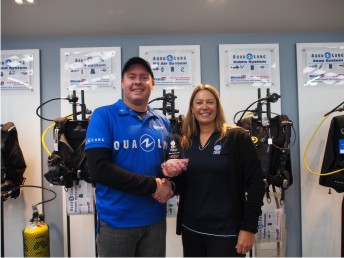 We were very proud in 2016 to receive the shop award from PADI Asia Pacific in recognition of "Outstanding Contribution to the Diving Industry".
Jen Clent PADI Regional Manager for New Zealand presents the award to Malcolm Kidd - MD Dive Centre Ltd.
At the same time Jen also presented Matt Shortall, Dive Centre's long serving Instructor with the "Outstanding Contribution to Diver Training Award" due to his consistent excellent work and issuing almost 200 certifications last year!
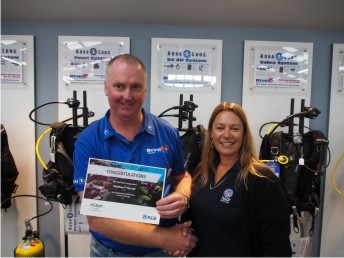
Jen Clent PADI Regional Manager for New Zealand presents the award to Matthew Shortall - Dive Centre Ltd Master Instructor.
We also became New Zealand's first PADI Tec Rec Training Centre! Offering a wide range of Technical, Deep, Mixed Gas and Solo Dive courses - Phone Matt Shortall for more info on 09 444 7698 now!
Go deeper and longer than you ever have before!
Don't forget - divers are now able to take a 20 scallop catch for one boat driver and one safety person as well as for each diver!
Scallop Season Dates: September 1st - March 31st
Remember to get your scallop float and flag out of the cupboard, and use it!
If you catch a Cray and it has a tag attached to its tail, what should you do? We have had several customers call us and ask, so here's what you should do...
Call the NZ Rock Lobster Industry Council on (04) 385 4005 and report the number on the tag, and where it was caught. This is a study that is trying to gain an insight into Crayfish migratory patterns, and behaviour so NZ can better manage it's fantastic Crayfish population.
Give them a hand by calling in whenever you catch a tagged crayfish.
By Hon Phil Heatley, Fisheries 01 September 2009
New fishing rules that came into affect on 1 October 2009 bring good news for recreational fishers nationwide, says Minister of Fisheries Phil Heatley. The main thing for Scuba Divers is the following...
Hand-operated lassoes - lobster
Recreational fishers gathering rock lobster (crayfish) will be able to use hand-operated lassoes in all New Zealand waters. Also known as cray-loops, this method is likely to be less damaging than some currently permitted methods and will also improve recreational divers' ability to safely catch rock lobster. Spring-loaded lassoes will be banned however. "Spring loaded lassoes can damage lobsters and reduce the chances of lobsters surviving upon release," Mr Heatley said. Current research suggests hand-operated lassoes cause fewer injuries to both soft and hard shell lobsters than hand gathering, which is an already permitted method. "This is a common-sense and practical change that will help divers catch lobsters while minimising the risk of causing damage to lobsters in the catching process. It will also make the rules about lassoes much clearer and easier to enforce" The New Zealand Recreational Fishing Council provided survey results on the impact of rock lobster hand-operated lassoes and along with the National Rock Lobster Management Group supported the change to regulations to allow the method to be introduced.
Hand-held lassoes for catching rock lobster
• Fisher ingenuity and gear technology developments often lead to fishers trying new harvesting methods that may be undefined and not explicitly regulated.
• In 2005, the previous Minister of Fisheries reviewed recreational rock lobster fishing methods and made provisions for some new methods, but retained the restriction on lassoes until there was sufficient information about their potential impacts on rock lobsters.
• The New Zealand Recreational Fishing Council submitted new information in 2008 on the impacts of lassoes on rock lobsters. Based on the results of their 2006 survey, it was concluded that the use of handoperated lassoes causes significantly fewer injuries to both soft and hard-shell lobsters than hand gathering (a permitted method).
• Hand-operated lassoes are a species-specific target method that is unlikely to affect or impact other marine life or the surrounding environment.
Daily bag limits of six lobsters per fisher per day are in place to control overall catch in the amateur sector.
So great news that common sense has prevailed!
Read the trip report below!
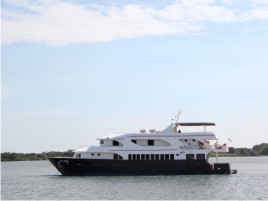
Galapagos Trip Report: Once in a Lifetime Dive Trip!
Text & Images by Malcolm & Barbara Kidd
The two days flying and sitting around airports with barely any sleep are forgotten...
The earthquake we experienced in the Santiago Airport is but a distant memory…
The 17 hour crossing on our liveaboard dive boat from the main island to get here is not even in my mind...
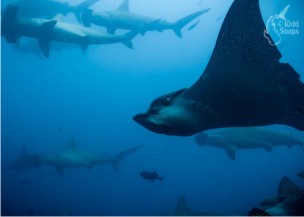
I’m sitting just 14m underwater on a shelf on the southern side of Wolf Island in the Galapagos looking at something I’ve waited my whole life to see... schooling Hammerheads... not just a few... hundreds!
Apart from the hundreds of Hammerhead’s parading in front of us, there are curious Galapagos sharks (looking more intimidating than the hammerheads), schools of the biggest eagle rays we’ve ever seen circling so close we could touch them, cruising turtles, and so many fish that they photo bomb the photos we’re trying to take of the sharks. This really is a diver’s dream and enough to make even decades-experienced divers beam with joy and wax lyrical about all they saw once back on board the boat.I eventually stop taking pictures on my new camera system, stop shooting video through the GoPro attached on top, and I just let myself take it all in... I’m underwater in the Galapagos Islands and they’re here! It was the start of an amazing 8 days of diving and land tours that we’d planned for almost two years and saved for just as long.
Galapagos isn’t easy – it’s one of the hardest dive sights to get to, and the conditions are not perfect flat calm diving like your normal tropical destinations. But all that is forgotten when you hit the water – and for a kiwi diver it feels familiar and even looks similar to many Hauraki Gulf Islands both above and below the water (apart from the inhabitants!)
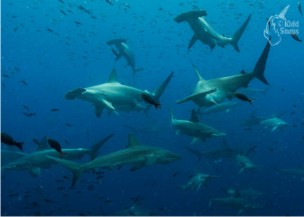 The reason it’s such good diving is that there are seven different oceanic currents that hit the Galapagos, but the main one is the largest upwelling system in the world, called the “Humboldt” cold water current. This is the most productive on earth with almost 20% of all fish caught on the planet bathed by its flow! This, combined with warm tropical currents, is why there’s so much life here and why we have to be prepared for temperature ranges of 14 – 25 degrees underwater!
We visit an island to see Land Iguana’s and are amazed at how close we can get without startling them – great pictures are almost embarrassingly easy! Sea Lions lie ignoring you on the sand while you take pictures of “Blue Footed Boobies” (yes, that is their real name!) performing mating rituals and making nests and tending to eggs while Frigate birds with huge red waddles try and attract mates in front of beaming people glued to their cameras! We look out to sea and watch acres of dolphin leap and play in the water surrounding the island – this place is just so full of life you don’t know where to look or point the camera!
Then we’re back to the main boat to travel another 6-7 hours north to Darwin Island and more importantly Darwin’s Arch. For me, this is the focus of the trip – it can make or break the whole two weeks if they’re not there!
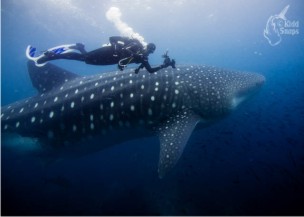
I shouldn’t have worried... 4 minutes into the first dive – the guide suddenly frantically signals and points before disappearing as fast as he can into the blue. We follow, kicking as fast as we can – all scared we won’t see her... But there she is – a 15m pregnant Whale Shark – she’s huge (even for a Whale Shark!). And we get closer than I thought we would – I get so close I’m being pulled along in her slipstream, and I can slow my kicking right down and glide with her like I’m a remora. One of the coolest moments I’ve ever had underwater!
I look to my buddies and they’re all having a blast, I look to the huge schools of big eye Trevalley, the Hammerhead and Galapagos Sharks in the distance, the Turtle posing for pictures, and the millions of other fish that surround us all at once and think... This is what diving is all about!
We end up seeing a total of 14 Whale Sharks during our dives at Darwin’s Arch and on the last dive – like most trip organisers before me – I have a quiet sigh of relief that it’s all been so amazing... then I turn back to my camera before I miss the next shot. You can never have too many Whale Shark pictures!
We're back from the Galapagos Islands now and it was the best dive trip we've ever done! There is something we got wrong though... “Once in a Lifetime” isn’t correct - we are so going back!